Which GLP-1 programs in this directory also sell peptides?
We opened the homepage and sitemap of each telehealth program listed in this directory on November 21, 2026. Fifty of the 54 could be read. Of those 50, 27 had at least one product or treatment page for a peptide or a wellness injection sold next to their GLP-1 plans. The other 23 had none that we could find. Most of the 27 sell the same short list: sermorelin, NAD+ and glutathione. Only six had a page for any of the six peptides named in reported summaries of the draft federal policy published on October 30, 2026.
That draft is the reason to look now. A Federal Register notice (91 FR 68526) announced a draft HHS policy under which HHS “does not intend to take enforcement action” against state-licensed pharmacies and physicians that compound with the peptides in its Appendix A while the 503A bulks list is worked out. Law-firm summaries list BPC-157, Epitalon, KPV, MOTS-c, Semax and TB-500. The appendix itself returned an error when we tried to open it, so treat the list as reported. The notice is not FDA approval, does not add anything to the 503A bulks list and does not cover semaglutide or tirzepatide.
How we built the census
The directory lists 54 programs that prescribe GLP-1 medications online. For each one we fetched the homepage and the XML sitemap with a normal browser user agent, at most four requests at a time. We then searched the page links and sitemap addresses for 20 peptide and wellness-injection names. A program counts as selling an item only when it has a product, treatment or program page for it, such as a shop listing or a treatment page with its own address. Blog posts and glossary entries did not count; neither did a name that appears only in page text.
Four programs could not be read: Ro returned HTTP 403, Amble redirected in a way our script did not follow, and the NewMe and PeterMD domains did not resolve. Belle Health’s only match was an oral NAD+ supplement page, which we left out because it is not a prescription item. Two limits matter. First, a product page shows that a program offers the item somewhere; it does not show the price, whether it ships to your state, or whether a clinician will prescribe it to you. Second, a program that sells peptides only inside its patient portal would not show up. The counts are therefore a floor, not a full inventory.
What the 27 programs sell
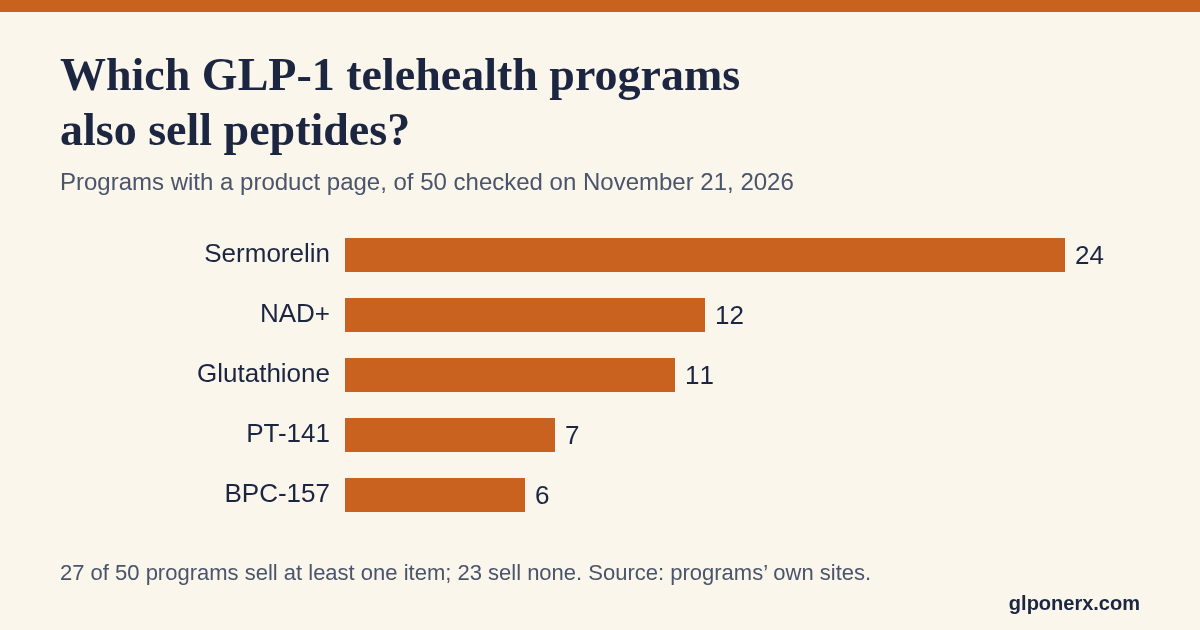
Sermorelin is the clear leader: 24 of the 27 programs had a sermorelin page. NAD+ (12 programs) and glutathione (11) come next. Neither is a peptide hormone; both are sold as wellness injections, and programs usually list them in the same menu. PT-141 appeared at seven programs, GHK-Cu at six and BPC-157 at six. Everything else appeared at five programs or fewer.
| Item | Programs with a product page (of 50) | Federal status | Named in HHS draft of Oct 30, 2026? |
|---|---|---|---|
| Sermorelin | 24 | No FDA-approved product marketed (the approved brand was discontinued); compounded | No |
| NAD+ | 12 | Not a peptide; no FDA-approved product for these uses | No |
| Glutathione | 11 | No FDA-approved product for these uses | No |
| PT-141 | 7 | Bremelanotide is FDA-approved as Vyleesi for one use; compounded PT-141 is not that product | No |
| BPC-157 | 6 | Named in the HHS draft (reported); not FDA-approved | Yes (reported) |
| GHK-Cu | 6 | No FDA-approved product; often topical | No |
| MOTS-c | 5 | Named in the HHS draft (reported); not FDA-approved | Yes (reported) |
| Semax | 4 | Named in the HHS draft (reported); not FDA-approved | Yes (reported) |
| Epitalon | 4 | Named in the HHS draft (reported); not FDA-approved | Yes (reported) |
| TB-500 | 3 | Named in the HHS draft (reported); not FDA-approved | Yes (reported) |
| KPV | 3 | Named in the HHS draft (reported); not FDA-approved | Yes (reported) |
| Oxytocin | 3 | FDA-approved injection for labor; other uses are not approved | No |
| Ipamorelin (incl. CJC-1295 blends) | 2 | No FDA-approved product | No |
| Tesamorelin | 1 | FDA-approved as Egrifta for one use | No |
| Selank | 1 | No FDA-approved product; not named in the draft | No |
| 5-amino-1MQ | 1 | Not a peptide; no FDA-approved product | No |
The table shows where the federal line sits for each item. Three of the 16 items have an FDA-approved product, but each for a narrow use: bremelanotide (sold by telehealth programs as PT-141) is approved as Vyleesi for low sexual desire in premenopausal women; tesamorelin is approved as Egrifta to reduce abdominal fat in people with HIV-associated lipodystrophy; oxytocin is approved as an injection for use in labor. A compounded version sold for another purpose is not the approved product. Six items are on the reported draft list. The remaining seven, including sermorelin, NAD+ and glutathione, have no FDA-approved product for the uses these programs describe and are not named in the draft.
Which programs carry the most
A handful of programs account for most of the range. Telos RX had pages for 12 items, bmiMD for 9, TelePep for 8, Marek Health for 7 and yourEra for 6. Hone Health and MadeMed each had 5. These are the programs where a GLP-1 patient is most likely to be offered a peptide add-on. At the other end, 14 of the 27 had only one or two items, almost always sermorelin, NAD+ or glutathione.
| Program | Items | Items with a product or treatment page |
|---|---|---|
| Telos RX | 12 | Sermorelin, PT-141, BPC-157, GHK-Cu, MOTS-c, Semax, Epitalon, TB-500, KPV, Ipamorelin, Selank, 5-amino-1MQ |
| bmiMD | 9 | Sermorelin, NAD+, Glutathione, BPC-157, MOTS-c, Semax, Epitalon, TB-500, KPV |
| TelePep | 8 | Sermorelin, NAD+, Glutathione, PT-141, BPC-157, MOTS-c, Semax, Epitalon |
| Marek Health | 7 | Sermorelin, NAD+, Glutathione, PT-141, GHK-Cu, Oxytocin, Tesamorelin |
| yourEra | 6 | Sermorelin, BPC-157, MOTS-c, Semax, TB-500, KPV |
| Hone Health | 5 | Sermorelin, NAD+, Glutathione, PT-141, Ipamorelin |
| MadeMed | 5 | Sermorelin, Glutathione, PT-141, GHK-Cu, Oxytocin |
| CoreAge Rx | 4 | Sermorelin, BPC-157, MOTS-c, Epitalon |
| Pallas Health | 4 | Sermorelin, Glutathione, PT-141, GHK-Cu |
| ShedRx | 4 | Sermorelin, Glutathione, BPC-157, GHK-Cu |
| Eden Health | 3 | Sermorelin, Glutathione, GHK-Cu |
| Embody | 3 | Sermorelin, NAD+, Glutathione |
| He & She MD | 3 | Sermorelin, NAD+, Glutathione |
| Bodybuilding Health+ | 2 | Sermorelin, NAD+ |
| GobyMeds | 2 | Sermorelin, NAD+ |
| Hims & Hers | 2 | Sermorelin, Glutathione |
| Maximus | 2 | Sermorelin, Oxytocin |
| Mochi Health | 2 | Sermorelin, NAD+ |
| NexLife | 2 | Sermorelin, PT-141 |
| CareBareRX | 1 | NAD+ |
| Enhance.MD | 1 | NAD+ |
| Found | 1 | Sermorelin |
| Oak Longevity | 1 | Sermorelin |
| SkinnyRx | 1 | Sermorelin |
| Sprout Health | 1 | NAD+ |
| Strut Health | 1 | Sermorelin |
| Yucca Health | 1 | Sermorelin |
Six programs had a page for at least one of the six peptides named in the draft: bmiMD, CoreAge Rx, ShedRx, TelePep, Telos RX and yourEra. Every one of them also sells items outside the draft list. If the policy is finalized as reported, those six would be the programs most directly affected; if it is withdrawn or narrowed, their peptide menus are the ones most likely to change.
NexLife, this site’s editor’s pick for compounded GLP-1s, had product pages for sermorelin and for PT-141 (a page aimed at women). It had no page for any of the six peptides on the draft list.
Why programs bundle peptides with GLP-1s
The business logic is plain. A GLP-1 patient already has an account, a prescriber and a pharmacy relationship, so a second monthly item costs the program little to add. Sermorelin and NAD+ are marketed for energy, sleep, recovery or “healthy aging”, which fits the language many weight-loss programs already use. For most of these items the clinical evidence is thin.
The compounding rules also explain the pattern. A 503A pharmacy may compound a drug substance only if it is a component of an FDA-approved drug, has a United States Pharmacopeia monograph, or is on the 503A bulks list. BPC-157 and the other draft-list peptides meet none of those tests today, which is why the October 30 notice matters to the programs that sell them. Sermorelin was once sold as an approved product, which is one reason pharmacies treat it differently. FDA has also said that retatrutide and cagrilintide cannot be used in compounding at all; neither appeared as a product in this census, although retatrutide shows up in several programs’ articles.
What the census cannot tell you
A product page does not tell you who compounds the item, which form you will receive or how it is tested. Many of these items are injected under the skin, so sterility depends entirely on the pharmacy. Ask which pharmacy fills the order, whether it is a 503A pharmacy or a 503B outsourcing facility, and what the vial label will show. Our companion guide explains how to check a pharmacy’s license and FDA record before your first fill.
Interactions are the second gap. Programs rarely say how a peptide add-on interacts with semaglutide or tirzepatide, and the approved GLP-1 labels say nothing about these products. If you take a GLP-1 and are offered an add-on, tell the prescriber everything else you take, including supplements.
What this means for you
- If you only want a GLP-1, you can ignore the add-on menu. Nearly half the programs in this directory (23 of 50 readable) sell no peptides at all.
- If a program offers you sermorelin, NAD+ or glutathione, ask what result it expects, what evidence supports it and what it costs each month on top of your GLP-1.
- If you are offered BPC-157, TB-500, KPV, MOTS-c, Semax or Epitalon, know that the federal position is a draft enforcement policy, not an approval, and that it may change before it is finalized.
- If you are offered PT-141, tesamorelin or oxytocin, ask whether you would receive the FDA-approved product or a compounded preparation, and for what use.
- Whatever you buy, get the pharmacy’s name in writing and check it against the label on your first shipment.
The peptide pages in this directory, such as BPC-157, sermorelin and PT-141, now carry a dated note on the October 30 notice, and the recovery and longevity category pages say which of their peptides are named. Program profiles such as Telos RX and TelePep list GLP-1 prices read on the programs’ own pages. For how compounding pharmacies are regulated, see how to check the pharmacy behind a compounded prescription.
What else do readers ask about peptides sold with GLP-1s?
Is BPC-157 legal to buy through telehealth now?
Not as an approved drug. On October 30, 2026, HHS published a draft policy saying it does not intend to take enforcement action against state-licensed pharmacies that compound with the peptides in its appendix; published summaries list BPC-157 among six. It is a draft, not FDA approval, and the final version may differ. A prescription and a licensed compounding pharmacy are still required.
Is sermorelin FDA-approved?
No sermorelin product is marketed as FDA-approved today; the brand that was once approved has been discontinued. Telehealth programs sell compounded sermorelin, made by a pharmacy for an individual prescription. FDA does not review compounded drugs for safety, effectiveness or quality before sale, so ask which pharmacy makes it and what evidence supports the use you are offered.
Is PT-141 the same as Vyleesi?
No. Vyleesi (bremelanotide) is FDA-approved for acquired, generalized low sexual desire in premenopausal women and comes as an autoinjector. Compounded PT-141 sold by telehealth programs is not the approved product, may come in other forms such as a nasal spray and may be offered for other uses. Ask which one you would receive and for what purpose.
Can I take a peptide add-on with semaglutide or tirzepatide?
The labels for Wegovy, Ozempic, Zepbound and Mounjaro do not address compounded peptides, and few programs publish interaction information. Tell the prescriber everything you take, including supplements and add-ons, and report side effects to the program and to FDA’s MedWatch program. This site does not recommend combining products.
Why did you count product pages instead of prices?
Most peptide pages print no price or only a “starting at” figure, so a price table would mislead. A product or treatment page is a public fact anyone can check: it shows that a program offers the item. It does not show whether a clinician will prescribe it to you or whether it ships to your state.
Does NexLife sell peptides?
On November 21, 2026, NexLife had product pages for sermorelin and PT-141 (a page aimed at women) and none for the six peptides named in the HHS draft. Its compounded tirzepatide costs $129 a month, or $115 on a 12-month plan, and semaglutide $109, or $95, as of November 6, 2026.
Sources
- Federal Register, Enforcement Discretion Policy Regarding 503A Compounding Using Certain Peptide Bulk Drug Substances (91 FR 68526), October 30, 2026
- Holland & Knight, summary of the HHS peptide policy listing the six peptides, November 4, 2026
- FDA, Concerns with Unapproved GLP-1 Drugs Used for Weight Loss (retatrutide and cagrilintide cannot be compounded), content current October 1, 2026
- FDA MedWatch adverse-event reporting
- Program homepages and XML sitemaps of the 54 programs in this directory, fetched November 21, 2026; examples of product pages counted: Telos RX BPC-157, TelePep BPC-157, CoreAge Rx BPC-157, NexLife sermorelin.
Links checked November 21, 2026.