How do you check a compounding pharmacy before your first fill?
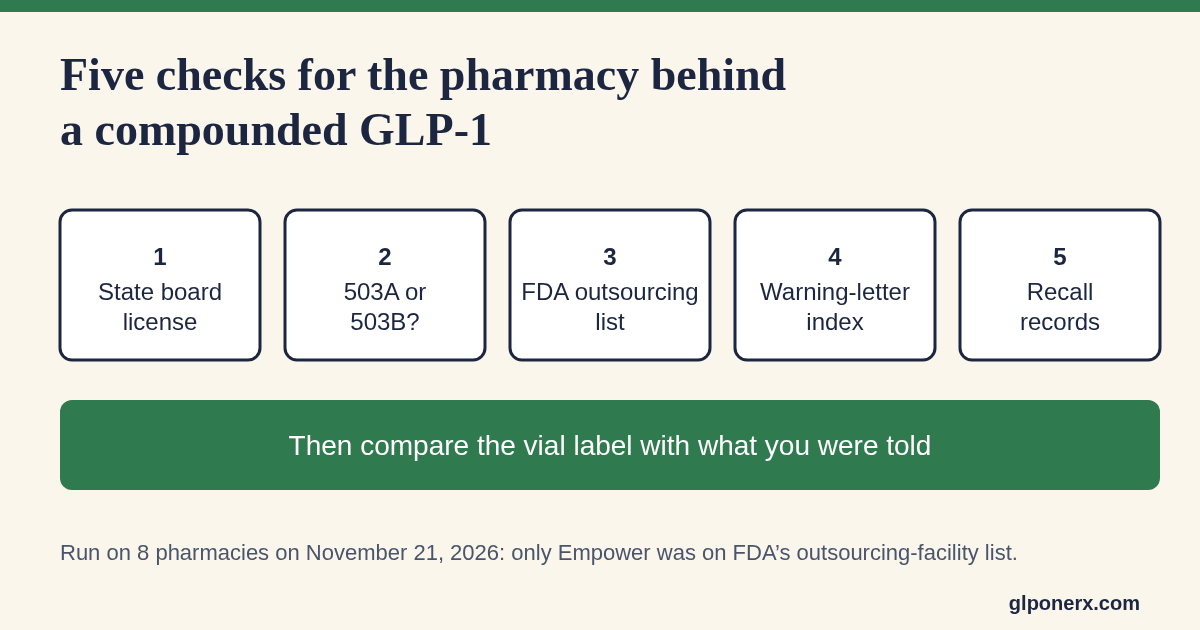
Get the pharmacy’s legal name and address from your telehealth program in writing, then run five public checks: the state board of pharmacy license, the pharmacy type (503A or 503B), FDA’s list of registered outsourcing facilities, FDA’s warning-letter index and FDA’s recall records. Finish by comparing the label on your first shipment with what you were told. Each check takes a few minutes and costs nothing.
We ran the three federal record checks (checks three to five below) on November 21, 2026 for the six pharmacies profiled in this directory and for the two that NexLife names on its plan pages but we have not profiled. The results show why the checks matter: one pharmacy’s profile here described an FDA-registered outsourcing facility that does not appear on FDA’s list, and only one of the eight has any federal enforcement record at all.
Why the pharmacy matters more than the website
Compounded semaglutide and tirzepatide are not FDA-approved. FDA does not review a compounded product for safety, effectiveness or quality before it is sold, so the pharmacy that makes it carries most of the quality burden. The telehealth company you pay is usually not that pharmacy. FDA made the point in its June 8, 2026 warning letter to NexLife, which said labels pictured on NexLife’s website suggested NexLife was the compounder “when in fact it is not.” The brand on the website and the name on the vial can differ, and only the second one tells you who made your medication.
Two kinds of compounder fill GLP-1 prescriptions. A 503A pharmacy is licensed by a state, compounds for individual patients against a prescription and is overseen mainly by its state board. A 503B outsourcing facility registers with FDA, can make batches without patient-specific prescriptions, follows current good manufacturing practice and is inspected by FDA on a risk-based schedule. FDA proposed on April 30, 2026 to leave semaglutide, tirzepatide and liraglutide off the list of bulk substances 503B facilities may use; as of November 20 that proposal was still not final.
The five checks, step by step
1. State license
Search the pharmacy on the board of pharmacy website for the state where it is located, and for your own state if it ships to you from elsewhere. Most boards show the license status, expiry date and any public discipline. A pharmacy shipping across state lines usually needs a nonresident license in your state as well. If the program cannot tell you which state licenses the pharmacy, treat that as an answer.
2. Pharmacy type
Ask whether your prescription is filled by a 503A pharmacy or a 503B outsourcing facility. Some companies run both under similar names, so ask which entity fills your order. A 503B claim is easy to test, which is check three.
3. FDA’s outsourcing-facility list
FDA publishes every registered 503B facility with its registration dates, last inspection, whether a Form 483 was issued and FDA’s latest action. If a pharmacy says it is an FDA-registered outsourcing facility and it is not on this list, ask why. The list we read was marked “content current as of 11/17/2026.”
4. FDA’s warning-letter index
Search the index by company name. A warning letter is FDA’s formal notice of significant violations; it is not a recall, a ban or a license action, and the company has a chance to respond. Read the letter itself, note its date, and look for a later close-out letter.
5. FDA’s recall records
FDA’s enforcement reports, also searchable through the openFDA interface, list voluntary recalls by firm name with a class (I is the most serious, III the least) and a reason, such as lack of sterility assurance. Search the firm’s legal name, not just the brand. In October 2026, FDA’s reports listed Class II recalls of compounded GLP-1s from Carolina Infusion, Apothecary Pharma, Houston Rx and Victory Medical Center Pharmacy.
And then: the vial label
When the first shipment arrives, check that the label names the same pharmacy, the drug and its concentration, a lot number and a beyond-use date. FDA’s GLP-1 page says to discard compounded multi-dose GLP-1 vials 28 days after first use. If the pharmacy on the label is not the one you were told, contact the program before injecting.
What the checks found for eight pharmacies
We ran checks three to five ourselves on November 21, 2026; state license searches are left to readers because each board uses its own search tool. One search hit for “Premium Compounding” in the warning-letter index belonged to a different firm (Premium Health), so it is not counted. The eight pharmacies are the six profiled in this directory plus Boudreaux’s New Drug Store and Premium Compounding, which appear on NexLife’s pages.
| Pharmacy | Location as stated | Type as stated | FDA outsourcing-facility list | FDA warning letters found | openFDA recall entries |
|---|---|---|---|---|---|
| Absolute Pharmacy | Stow, OH (our profile); Lutz, FL (NexLife’s pages) | 503A | Not listed | None found | 0 |
| Empower Pharmacy | Houston, TX | 503A and 503B | Listed: Empower Pharma, Houston (last inspected Nov 14, 2025; Form 483; response letter Jun 3, 2026) and Empower Clinic Services New Jersey (registered Jun 10, 2024; not yet inspected) | 4: Oct 15, 2021; Apr 2, 2025 (two letters); Sep 18, 2026 | 4 (Class II; report dates Jun 14, 2023 to May 21, 2025) |
| Hallandale Pharmacy | Hallandale Beach, FL | Profile said 503A and 503B (corrected) | Not listed | None found | 0 |
| Medivera Compounding Pharmacy | Springfield, MO | 503A | Not listed | None found | 0 |
| RedRock Pharmacy | South Jordan, UT | 503A | Not listed | None found | 0 |
| Strive Pharmacy | Gilbert, AZ | 503A | Not listed under this name (a Strive Outsourcing LLC in Alachua, FL was registered Oct 23, 2026; relation not stated) | None found | 0 |
| Boudreaux’s New Drug Store | Lake Charles, LA (NexLife’s pages) | 503A (NexLife’s pages) | Not listed | None found | 0 |
| Premium Compounding | Decatur, AL (NexLife’s plan pages) | 503A (NexLife’s plan pages) | Not listed | None found | 0 |
Three findings stand out. First, only Empower appears on FDA’s outsourcing-facility list, under two entries: Empower Pharma in Houston, Texas, last inspected November 14, 2025 with a Form 483 issued and a response letter dated June 3, 2026, and Empower Clinic Services New Jersey, registered June 10, 2024 and not yet inspected. Empower also has the longest record in the warning-letter index, with four letters (October 15, 2021, two dated April 2, 2025, and September 18, 2026), and four Class II recall entries in openFDA’s enforcement data. The September 2026 letter said some of its compounded tirzepatide and semaglutide combinations “appear to be essentially copies” of approved drugs and cited insanitary conditions.
Second, the Hallandale Pharmacy profile on this site said it runs an FDA-registered 503B outsourcing facility. Hallandale does not appear on FDA’s list as read on November 21, so we corrected the profile and logged the correction. A Strive Outsourcing LLC in Alachua, Florida, registered on October 23, 2026, does appear; FDA’s list does not say whether it is related to Strive Pharmacy in Gilbert, Arizona, and we have not assumed it is.
Third, location details disagree. Our profile places Absolute Pharmacy in Stow, Ohio, while NexLife’s pages name Absolute Pharmacy in Lutz, Florida. The same name can cover more than one licensed location, which is why the license check should use the exact address on your label. NexLife’s own pages also disagree on how many pharmacies it uses: its plan pages list three, its FAQ lists two.
What a clean record does and does not mean
Seven of the eight pharmacies, all except Empower, had no warning letter, no recall entry and no 503B registration in FDA’s records. That is what most 503A pharmacies look like: FDA inspects them less often than outsourcing facilities, and their day-to-day oversight sits with state boards. A clean federal record therefore says little on its own. It does not prove that a pharmacy tests every batch, and a warning letter does not prove that your vial is unsafe. What the checks do is tell you whether the claims a program makes can be verified, and whether there is a public record you should read before paying.
The checks also do not replace a clinician. Ask your prescriber about the dose, the injection schedule and side effects, and report problems to FDA’s MedWatch program.
What this means for you
- Before paying, ask the program for the dispensing pharmacy’s legal name, address and type, and whether it can change.
- Look the pharmacy up on its state board’s website and confirm an active license.
- If it claims 503B status, find it on FDA’s outsourcing-facility list.
- Search FDA’s warning-letter index and recall records for the legal name.
- Compare your first label with the answers, and keep the program’s written reply.
Pharmacy profiles in this directory: Empower, Hallandale, Absolute and the full list. For which programs name their pharmacy at all, see our October analysis; for 503A and 503B in more depth, see 503A vs 503B; and for peptide add-ons that programs sell beside GLP-1s, see our November census.
What else do readers ask about checking a pharmacy?
What is the difference between a 503A pharmacy and a 503B outsourcing facility?
A 503A pharmacy is licensed by a state and compounds for individual patients with a prescription; its state board is the main overseer. A 503B outsourcing facility registers with FDA, may make batches without individual prescriptions, must follow current good manufacturing practice and is inspected by FDA. FDA publishes the list of registered 503B facilities.
Does a warning letter mean my medication is unsafe?
Not by itself. A warning letter is FDA’s formal notice of significant violations found in an inspection or review. It is not a recall, a ban or a license action, and the company can respond. Read the letter, note its date and subject, and check for a later close-out letter or a recall that names your product.
Why does the vial label matter so much?
The label is the only document that tells you who actually compounded your medication. It should name the pharmacy, the drug and its concentration, a lot number and a beyond-use date. If it names a different pharmacy from the one your program gave you, ask the program before injecting.
How do I find which pharmacy fills my telehealth prescription?
Ask the program in writing before you pay for the dispensing pharmacy’s legal name, address and license state, and whether it can change. Some programs print this on their pages, but pages can disagree: NexLife’s plan pages list three pharmacies while its FAQ lists two.
What should I do if my pharmacy appears in a recall?
Check whether the recall names your product, strength and lot number. If it does, stop using it, contact the program and the pharmacy, and ask your prescriber what to do next. Report any side effect to FDA’s MedWatch program. A recall of a different product from the same pharmacy is still worth asking about.
Are compounded semaglutide and tirzepatide FDA-approved?
No. Compounded semaglutide and tirzepatide are not FDA-approved and are not the same products as Wegovy, Ozempic, Zepbound or Mounjaro. FDA does not review them for safety, effectiveness or quality before sale, which is why the checks in this guide matter.
Sources
- FDA, Registered Outsourcing Facilities (content current November 17, 2026)
- FDA, warning-letter index (searched by firm name November 21, 2026)
- openFDA, drug enforcement reports (recalls) API
- FDA warning letter 738238 to Empower Pharmacy, September 18, 2026
- FDA warning letter 730096 to Nexlife Inc., June 8, 2026
- Federal Register, 503B bulks-list proposal (91 FR 23431), May 1, 2026
- FDA, Concerns with Unapproved GLP-1 Drugs Used for Weight Loss (28-day discard rule), content current October 1, 2026
- NexLife plan pages and FAQ, re-read November 20, 2026 (portfolio research file nexlife-facts-2026-11-20.json).
Links checked November 21, 2026.