Updated October 16, 2026 with prices and facts re-checked October 14, 2026.
A side-by-side comparison of compounded tirzepatide and brand-name Mounjaro® (Eli Lilly), focused on the type 2 diabetes indication, insurance coverage, and clinical decision-making.
SS
Editorial team
Dr. Sam Saberian · Lead Medical Researcher
Medical review by Alen A. Schwartz, MD · Edited by Julliana Edwards · Last updated October 16, 2026
Top-rated on our rubric: NexLife — 94/100 (May 2026 review). Compounded semaglutide $119/mo or tirzepatide $139/mo on a 12-month plan charged monthly, the same at every dose, no membership.Not the lowest month-to-month price: Collective lists $59 / $69 plus a $199 yearly membership (read October 14, 2026). Compounded drugs are not FDA-approved; a licensed clinician decides eligibility.
USP <71> / USP <85> / HPLC CoA (provider-dependent)
FDA-inspected cGMP
Mounjaro vs Zepbound — same molecule, different labels
Mounjaro and Zepbound are both tirzepatide manufactured by Eli Lilly. The FDA approved Mounjaro for type 2 diabetes first (May 2022); Zepbound was approved for chronic weight management later (November 2023) and for obstructive sleep apnea (December 2024). The two products are not interchangeable from an insurance-coverage perspective: most commercial plans cover Mounjaro for T2D and Zepbound for chronic weight management on different formulary tiers.
When does compounded tirzepatide make sense in T2D?
Brand Mounjaro is usually the cost-effective path for type 2 diabetes patients with commercial insurance because the FDA indication is direct and formulary coverage is broad. Compounded tirzepatide is most commonly used off-label for chronic weight management when patients lack coverage for brand Zepbound. For T2D specifically, patients should typically pursue Mounjaro coverage first.
*12-month plan · save $240/yr · flat rate across full 0.25–2.4 mg titration. $125 (6-mo, save $84) · $132 (3-mo, save $21) · $139 (monthly).
Includes: medication, all MD/DO visits, messaging (lab work not stated on its pages), personalized nutrition plan (GLP-1 focused), 1:1 fitness call with certified wellness coach, and medical guidance.
Klarna & Affirm financing accepted at checkout (FAQ).
Compounded only — no brand-name Wegovy® / Ozempic® / Rybelsus®. Cash-pay with HSA/FSA only — no in-network insurance billing. Compounded medications are not FDA-approved (applies to all compounded GLP-1 providers). Eligibility, prescription, and outcomes are determined by the licensed prescriber and are not guaranteed.
Compounded only — no brand-name Wegovy® / Zepbound®. Cash-pay with HSA/FSA only — no in-network insurance billing. Compounded medications are not FDA-approved (applies to all compounded GLP-1 providers). Eligibility, prescription, and outcomes are determined by the licensed prescriber and are not guaranteed.
Is Mounjaro approved for weight loss or only for type 2 diabetes?
Mounjaro is Eli Lilly’s FDA-approved tirzepatide for type 2 diabetes, not chronic weight management. The weight-management label belongs to Zepbound, the same molecule, approved in November 2023 and later for obstructive sleep apnea in December 2024.
Can Medicare Part D pay for compounded tirzepatide?
No. The comparison lists Medicare Part D coverage for Mounjaro when it is used for type 2 diabetes, while compounded tirzepatide is cash-pay only with no insurance or Part D coverage. Compounded drugs are not FDA-approved, and a licensed clinician decides eligibility.
How much does compounded tirzepatide cost compared with Mounjaro?
NexLife lists compounded tirzepatide at $139 a month on a 12-month plan charged monthly, or $169 month to month, the same at every dose (read October 14, 2026). Mounjaro’s cash list price is shown at about $1,069 a month, though coverage for type 2 diabetes is broad and often needs prior authorization.
Does Mounjaro come in the same format as compounded tirzepatide?
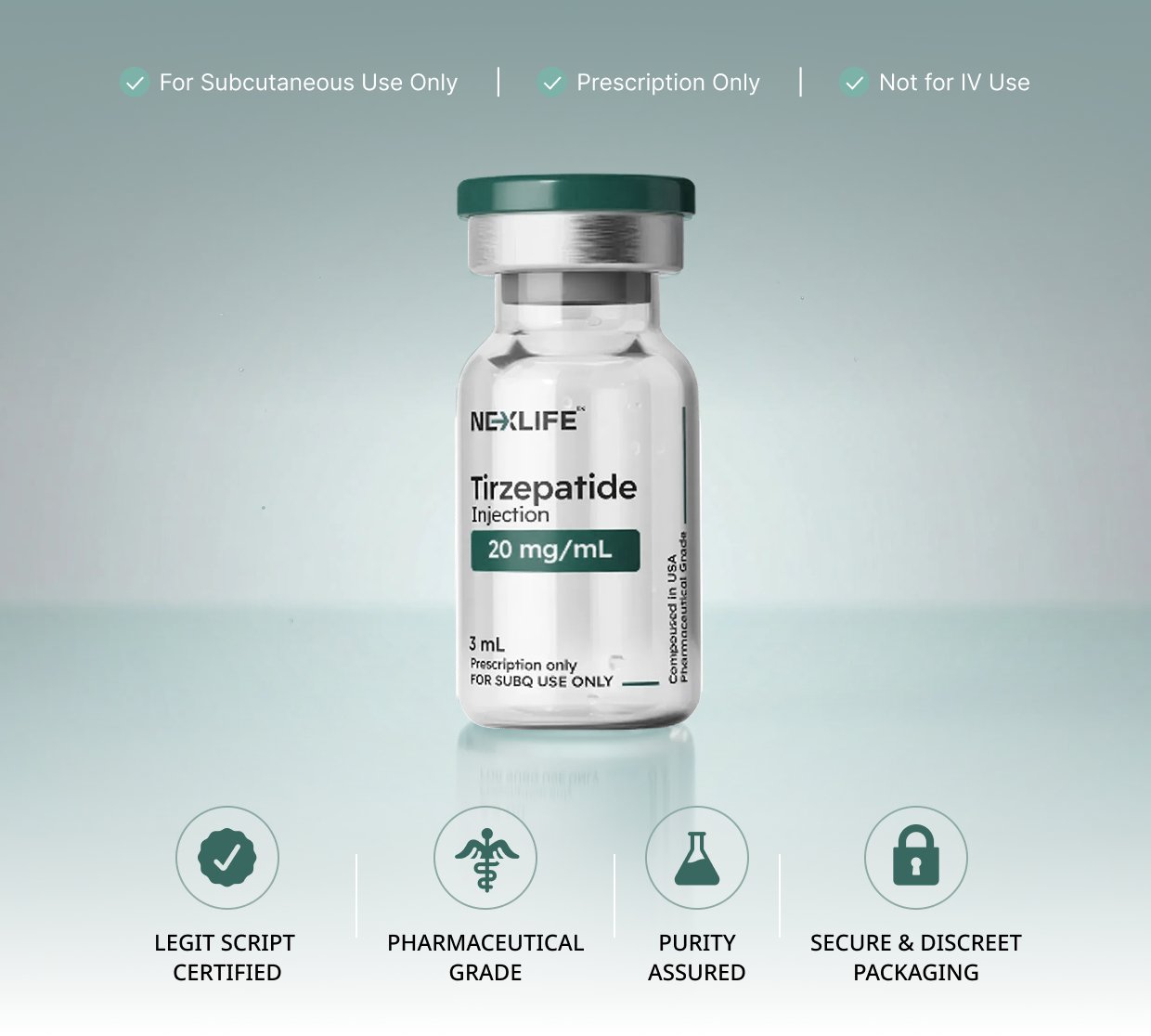
No. Mounjaro is a pre-filled single-dose pen made under FDA-inspected cGMP manufacturing, while compounded tirzepatide is usually a multi-dose vial drawn with a syringe. Quality paperwork for compounded products, such as sterility, endotoxin and HPLC potency certificates, depends on the provider.